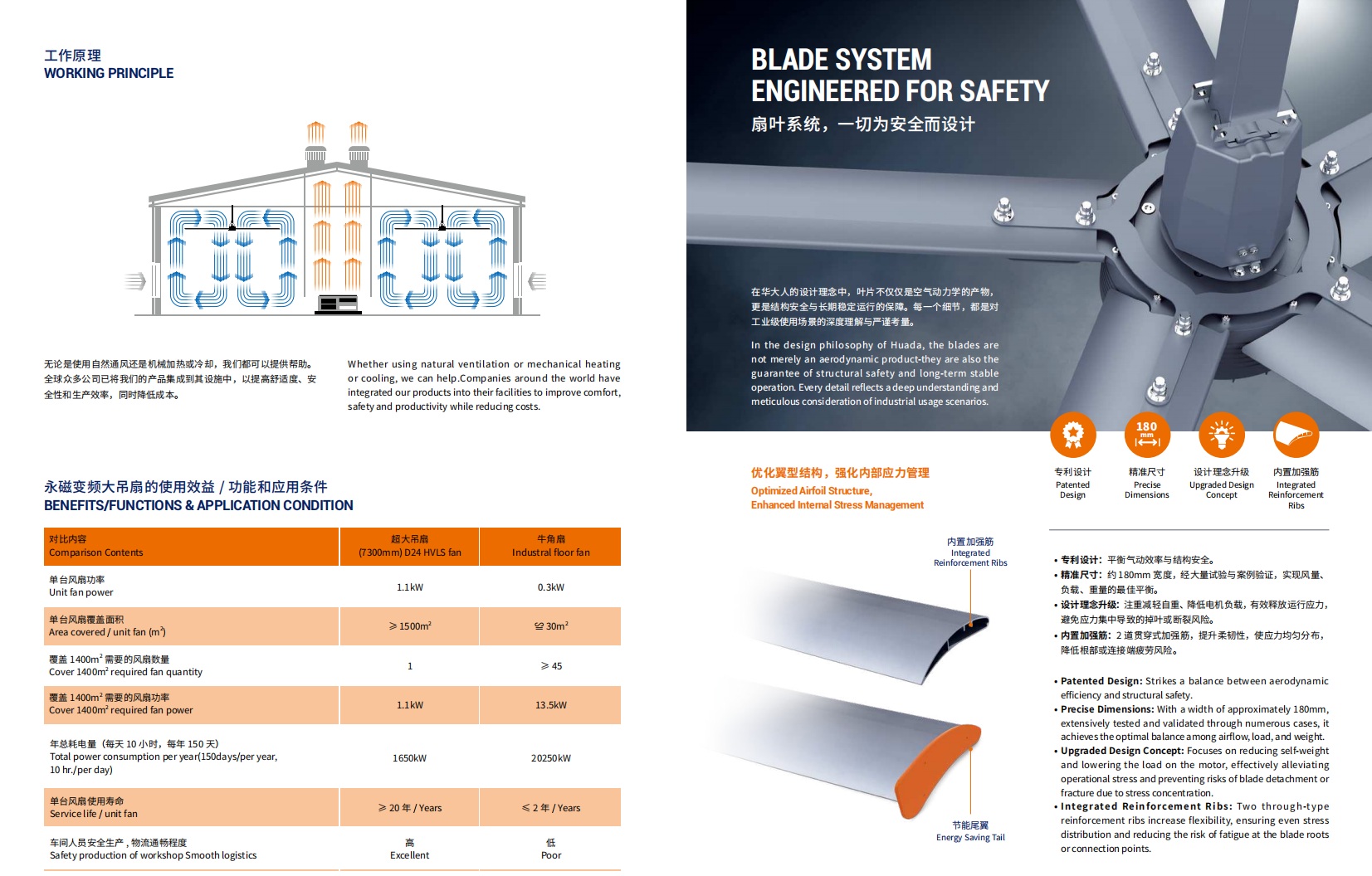
Choosing the correct diameter for an industrial ceiling fan is critical for optimal airflow and energy efficiency. A fan that is too small won't provide adequate coverage, while a fan that is too large wastes energy and may create uncomfortable drafts.
1. Why Diameter Matters
The diameter of an HVLS fan determines:
- Coverage area: Larger diameter = wider air column
- Airflow volume: Bigger blades move more air
- Energy efficiency: Larger fans can move more air with lower RPM, saving energy
- Noise level: Larger fans operating at lower speeds are typically quieter
GTFI's HDS series offers diameters from 3.0m to 7.3m, with corresponding airflow from 4,000 to 13,000 m³/min.
2. Diameter vs Coverage – Full Comparison Table
| Diameter | Power | Airflow | Coverage | Best For |
|---|---|---|---|---|
| 3.0m | 0.37kW | 4,000 m³/min | ~380㎡ | Small workshops, retail (≤200㎡) |
| 3.7m | 0.75kW | 5,000 m³/min | ~450㎡ | Gyms, medium workshops (200–400㎡) |
| 4.3m | 1.1kW | 7,000 m³/min | ~500㎡ | Warehouses, factories (300–500㎡) |
| 5.0m | 1.5kW | 10,000 m³/min | ~1,300㎡ | Large factories, logistics (500–1,000㎡) |
| 6.1m | 1.1kW | 11,500 m³/min | ~1,500㎡ | Large industrial spaces (800–1,200㎡) |
| 6.7m | 1.1kW | 12,000 m³/min | ~1,600㎡ | Warehouses, assembly halls (1,000–1,400㎡) |
| 7.3m | 1.1kW | 13,000 m³/min | ~1,700㎡ | Very large spaces, hangars (1,400–1,700㎡) |
3. Detailed Guide by Diameter
3m Diameter Fans (3.0–3.7m)
- Models: HDS-3.0, HDS-3.7, HDS-D series
- Best for: Small to medium workshops, retail stores, gyms, restaurants
- Ceiling height: 4–8 meters
- Coverage: 380–450㎡ per fan
- Example use: A 300㎡ gym would benefit from one HDS-3.7 or two smaller 3.0m fans for even coverage.
5m Diameter Fans (4.3–5.0m)
- Models: HDS-4.3, HDS-5.0
- Best for: Large workshops, warehouses, logistics centers, sports halls
- Ceiling height: 6–12 meters
- Coverage: 500–1,300㎡ per fan
- Example use: A 1,000㎡ warehouse typically needs one 5.0m fan or two 4.3m fans.
7m Diameter Fans (6.1–7.3m)
- Models: HDS-6.1, HDS-6.7, HDS-7.3
- Best for: Very large industrial facilities, aircraft hangars, large assembly halls
- Ceiling height: 8–18 meters
- Coverage: 1,500–1,700㎡ per fan
- Example use: A 5,000㎡ factory might use 3–4 HDS-7.3 fans for complete coverage.
4. How Many Fans Do You Need?
As a general rule, divide your total floor area by the coverage area of one fan, then add 10–20% for overlapping airflow. For example:
- 1,000㎡ space with HDS-5.0 (1,300㎡ coverage): 1 fan is sufficient
- 5,000㎡ space with HDS-7.3 (1,700㎡ coverage): 5,000 / 1,700 = 2.94 → 3–4 fans recommended
- 800㎡ space with HDS-3.7 (450㎡ coverage): 800 / 450 = 1.78 → 2 fans recommended
5. Ceiling Height Considerations
Higher ceilings require more powerful fans to push air to the floor. GTFI HDS series fans are designed for effective airflow at heights up to 18 meters. For very high ceilings (12–18m), choose larger diameter models (6.1–7.3m) to ensure adequate ground-level air movement.
6. Energy Efficiency by Diameter
Interestingly, larger fans are often more energy-efficient per square meter of coverage. For example:
- HDS-3.0: 0.37kW for 380㎡ = 0.97W/㎡
- HDS-5.0: 1.5kW for 1,300㎡ = 1.15W/㎡
- HDS-7.3: 1.1kW for 1,700㎡ = 0.65W/㎡
The HDS-7.3 is the most energy-efficient per square meter, making it the best choice for very large spaces.
Diameter and Layout
Ceiling height and obstruction layout can change the appropriate fan diameter and quantity. Compare the intended mounting height and airflow distribution before selecting a single diameter for the whole facility.
What to Confirm Before Ordering
- Record floor area, ceiling height, heat sources, occupancy, doors, and natural ventilation before comparing models.
- For fans, compare airflow, air velocity, coverage, speed control, mounting height, and noise rather than diameter alone.
- For cooling equipment, define target temperature, heat load, humidity, refrigerant/cooling method, and available electrical supply.
- Check dust, moisture, corrosive gases, outdoor exposure, and cleaning requirements when selecting protection and construction materials.
- Confirm installation clearances, controls, maintenance access, and whether several smaller units would distribute air more effectively than one large unit.
For a quotation request: For quotation requests, provide room dimensions, application, climate, electrical supply, preferred mounting method, and target operating conditions. This allows suppliers to recommend a suitable configuration rather than simply quoting the largest available model.
Need help matching equipment to a specific application? Provide the operating conditions, required quantity, destination, and key technical requirements when requesting a quotation.
❓ Frequently Asked Questions
A: No. Large fans require at least 6m clearance. Use smaller diameter fans (3–4m) for low ceilings.
A: Not necessarily. A fan that is too large for a small space can create uncomfortable drafts. Choose the diameter that matches your space size.
A: As a rule, space fans 1.5–2× their diameter apart. For 5m fans, spacing of 8–10m is typical.
💬 Need help calculating the right fan size for your space?
Ask Our Engineers →