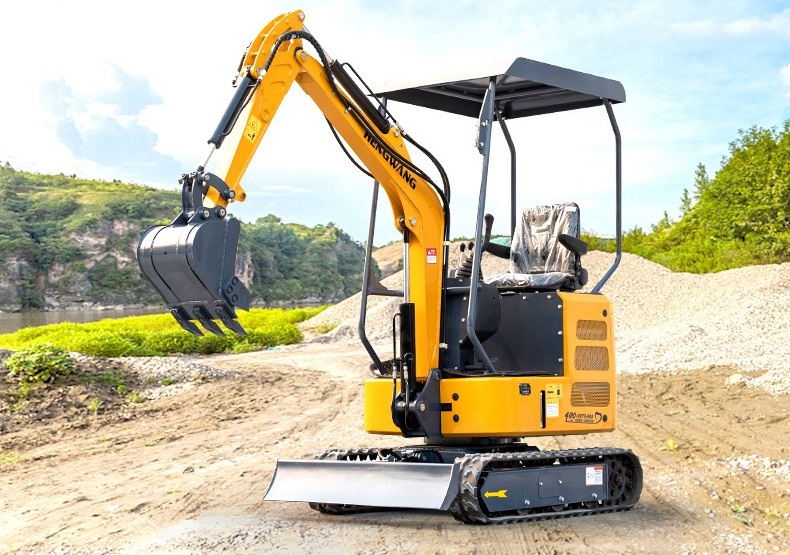
A hydraulic breaker (also called a hydraulic hammer) is one of the most useful attachments for mini excavators. It allows the excavator to demolish concrete, break rocks, and perform heavy demolition work that would be impossible with a bucket alone.
1. What Is a Breaker Attachment?
A breaker attachment uses hydraulic power from the excavator to drive a piston that delivers rapid, high-impact blows to a tool bit, breaking up hard materials like concrete, rock, asphalt, and frozen ground.
2. How to Choose the Right Breaker Size
- Excavator weight: The breaker weight should be approximately 10-15% of the excavator weight.
- Hydraulic flow: The breaker requires a specific hydraulic flow rate (L/min). Check your excavator's hydraulic specifications.
- Working pressure: Most mini excavators operate at 150-200 bar. Match the breaker to your excavator's pressure.
3. Breaker Size Recommendations
- 0.6-1.0 Ton Excavator: Use breaker weight 50-80kg. For light demolition and small rocks.
- 1.0-1.5 Ton Excavator: Use breaker weight 80-150kg. For general demolition and medium rocks.
- 1.5-2.5 Ton Excavator: Use breaker weight 150-250kg. For heavy demolition and large rocks.
- 2.5-3.5 Ton Excavator: Use breaker weight 250-400kg. For the heaviest demolition and rock breaking.
4. Key Features to Look For
- Auto-lubrication: Extends tool life and reduces maintenance
- Sound suppression: Reduces noise for residential and urban environments
- Quick-change system: Allows fast tool changes
- Shock absorption: Protects the excavator from vibration damage
5. Applications
- Demolition: Breaking concrete walls, floors, and foundations
- Rock breaking: Breaking rocks for excavation and construction
- Road work: Breaking asphalt and concrete pavement
- Mining: Breaking ore and rock in small mines
Practical Selection Checklist
Construction equipment should be selected around the job rather than around machine size alone. Excavators, transporters, and attachments must work within site access, ground conditions, lifting limits, transport restrictions, and the required production rate.
What to Confirm Before Ordering
- Define the material, digging or carrying task, working depth, reach, and expected daily workload.
- Check operating weight, machine width, height, ground clearance, turning space, and transport dimensions against the job site.
- Match engine power, hydraulic flow, attachment compatibility, and control system to the intended attachment and duty cycle.
- For tracked machines, consider slope, ground pressure, traction, mud, and the balance between mobility and payload.
- Confirm service access, wear parts, attachment availability, transport arrangements, and operator requirements before ordering.
For a quotation request: For quotation requests, provide the site conditions, required attachment, material, working depth or payload, access limits, destination country, and expected quantity. This produces a much more useful equipment recommendation.
Need help matching equipment to a specific application? Provide the operating conditions, required quantity, destination, and key technical requirements when requesting a quotation.
❓ Frequently Asked Questions
A: Most GTFI mini excavators support breaker attachments, but check the hydraulic flow and pressure specifications.
A: Breaker attachments range from $2,000 to $15,000 depending on size and quality. GTFI offers quality breakers at competitive prices.
A: Regular greasing is required every 1-2 hours of operation. Tool replacement is needed when the chisel wears down.
💬 Need help choosing a breaker for your excavator?
Talk to Our Experts →