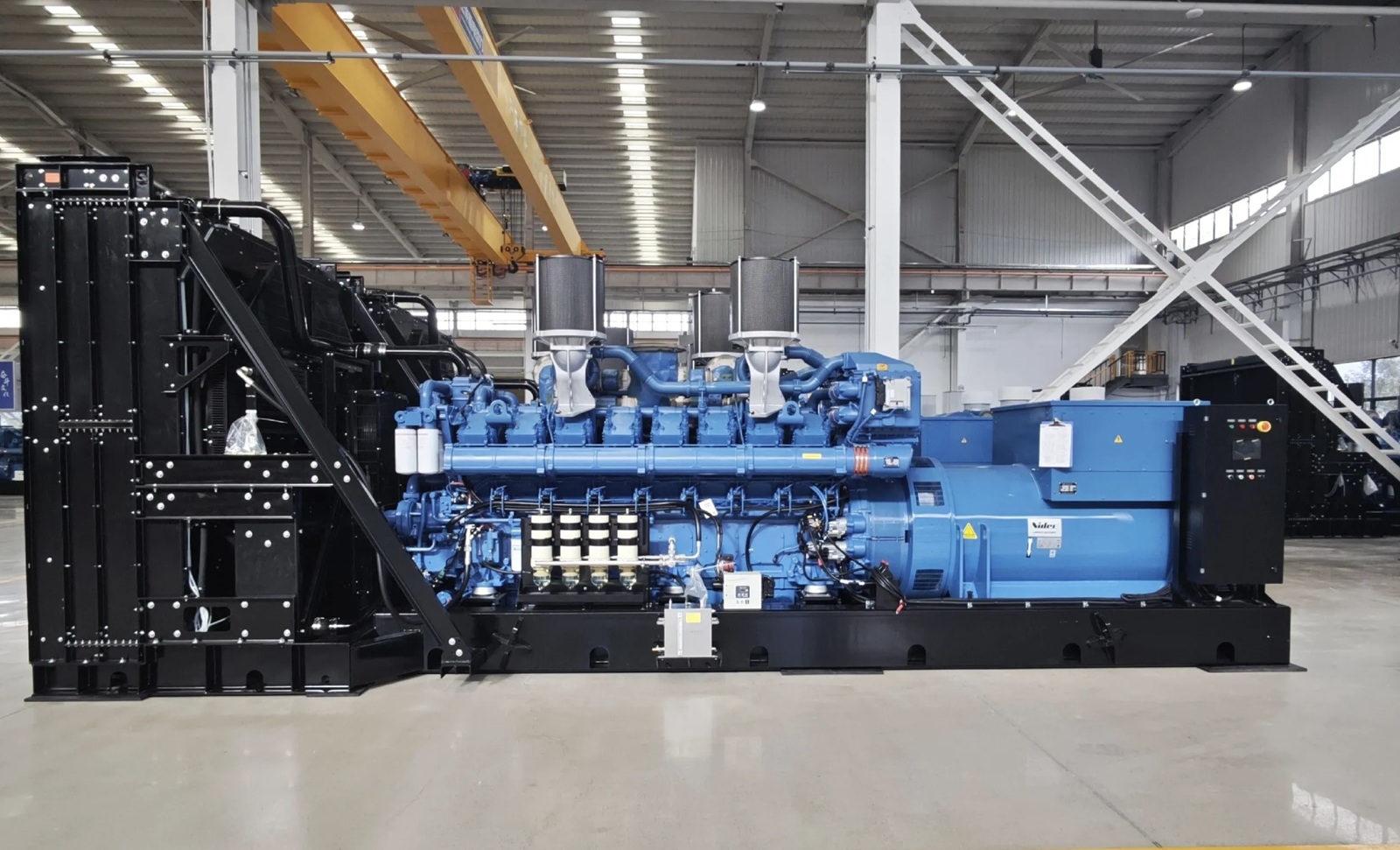
Data centers are the backbone of modern digital infrastructure. A power outage of even a few minutes can cause data loss, system failures, and significant financial damage. Backup generators for data centers must provide seamless, reliable, and high-quality power. This guide covers the critical considerations for selecting generators for data center applications.
1. Data Center Power Architecture
A typical data center power system includes:
- Utility feed: Primary power source
- UPS (Uninterruptible Power Supply): Provides continuous power during the transition (battery time: 5–15 minutes)
- Backup generators: Provide long-term power during extended outages (24–72+ hours)
- Automatic Transfer Switch (ATS): Automatically switches from utility to generator power
The generator must support the full data center load (IT equipment + cooling + lighting + systems) and be able to start and take load within 10–15 seconds (UPS bridge time).
2. Key Generator Specifications for Data Centers
2.1 Power Quality – THD
- IT equipment is sensitive: Servers, storage systems, and network equipment require clean power with THD <5%
- GTFI industrial gensets: Achieve THD <5% with premium alternators and AVR controllers
- Inverter generators: Provide THD <3%, ideal for sensitive electronics, but typically limited to smaller capacities (5–15kW)
2.2 Redundancy – N, N+1, or N+2?
- N: No redundancy – only the required number of generators
- N+1: One extra generator for maintenance or failure protection (recommended for Tier III data centers)
- N+2: Two extra generators – maximum reliability (Tier IV data centers)
Most data centers use N+1 or N+2 configurations with multiple generators in parallel operation.
2.3 Parallel Operation
- Load sharing: Multiple generators operate in parallel to share the load
- Scalability: Add generators as data center capacity grows
- GTFI parallel systems: Support up to 8 generators in parallel with synchronized control
2.4 Fuel Storage and Runtime
- Minimum runtime: 24–72 hours, depending on data center Tier rating
- On-site fuel tanks: Typically 8,000–50,000+ gallons for large data centers
- Fuel contracts: Many data centers have fuel supply contracts for emergency refueling
- Dual fuel: Natural gas + diesel or diesel + propane for extended emergencies
3. Recommended GTFI Data Center Generators
| Engine Brand | Power Range | Best For | Key Features |
|---|---|---|---|
| Cummins | 15–2,000+ kW | Premium data centers (Tier III/IV) | Global parts network, excellent performance, THD <5% |
| Perkins | 10–800 kW | Premium data centers | European quality, compact design |
| Weichai | 15–1,000 kW | Cost-effective, reliable | Excellent value, proven reliability, good parts availability in Asia |
| Yuchai | 10–600 kW | Heavy-duty applications | High quality, efficient, proven in Asia and Africa |
4. Installation Considerations
- Location: Ground floor or rooftop – must be accessible for maintenance
- Sound attenuation: Data centers are often located in urban or suburban areas – GTFI silent enclosures (68–72dB) plus additional sound walls if needed
- Exhaust management: Proper exhaust piping and emission control (SCR for EPA Tier 4 compliance)
- Cooling: Generators require adequate airflow for cooling – indoor units require ducting
- Fire suppression: Data center generator rooms require fire suppression systems
5. Testing and Maintenance
- Weekly load tests: Run generators under load (at least 30% of rated capacity) weekly
- Monthly full-load tests: Run at 100% load monthly to ensure full capacity is available
- Fuel polishing: Diesel fuel should be filtered and polished regularly to prevent degradation
- GTFI service: 24/7 support, spare parts availability, remote monitoring
Data Center Selection Notes
Data-center backup requires attention to critical-load hierarchy, redundancy, transfer strategy, cooling, fuel autonomy, monitoring, and testing. The generator should be evaluated as part of the complete backup-power system, not as an isolated engine-generator package.
What to Confirm Before Ordering
- List continuous loads and identify motors, pumps, compressors, welders, or other equipment with high starting current.
- Confirm rated and standby/maximum output figures and keep an appropriate operating margin instead of running continuously at the limit.
- Specify voltage, frequency, single-phase or three-phase output, and any required automatic transfer or remote-start functions.
- Consider fuel availability, expected daily runtime, tank size, refueling access, ambient temperature, altitude, and ventilation.
- For mobile or residential use, check enclosure, noise, wheel/transport requirements, weather protection, and safe exhaust routing.
For a quotation request: For an industrial quotation, provide the load list, target voltage/frequency, expected runtime, application, destination country, and required quantity. Those details make it easier to compare generator configurations on a like-for-like basis.
Need help matching equipment to a specific application? Provide the operating conditions, required quantity, destination, and key technical requirements when requesting a quotation.
❓ Frequently Asked Questions
A: GTFI generators start within 5–10 seconds, well within the UPS bridge time (5–15 minutes).
A: Typically 24–72 hours of runtime. For a 1,000kW generator, this requires 5,000–15,000+ gallons of diesel storage.
A: N+1 for Tier III, N+2 for Tier IV. GTFI parallel systems support both configurations.
💬 Need a custom data center backup solution?
Talk to Our Critical Power Experts →