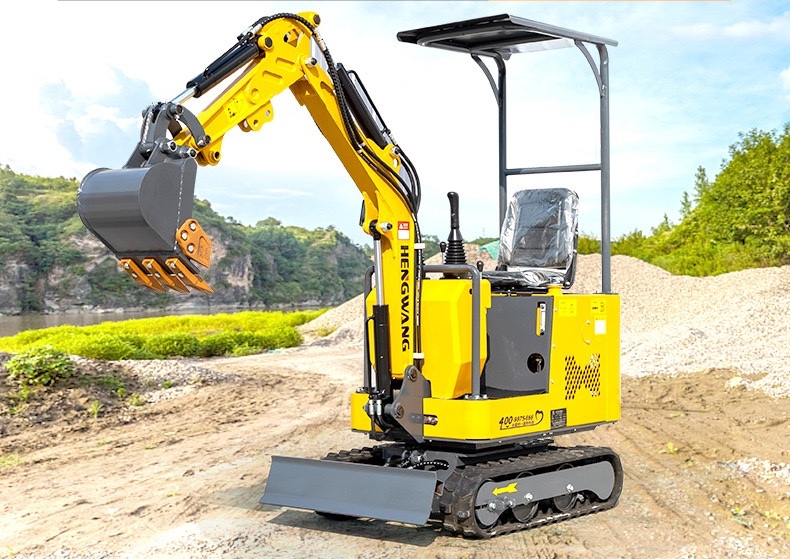
The bucket is one of the most important working tools on an excavator. Choosing the right bucket size directly impacts digging efficiency, fuel consumption, machine stability, and operational safety. An incorrect choice can lead to overloading, reduced productivity, or even machine damage.
GTFI mini excavators cover 0.6 to 3.5 tons with bucket capacities ranging from 0.018m³ to 0.1m³, configurable for different working conditions.
1. Bucket Capacity vs Excavator Tonnage
| Excavator Tonnage | Recommended Capacity | Typical Models | Best For |
|---|---|---|---|
| 0.6-0.8 Ton | 0.018-0.025m³ | 10-1, 10-2 | Narrow spaces, landscaping |
| 0.8-1.0 Ton | 0.025-0.03m³ | 13W, 15, 16W | Orchards, light excavation |
| 1.1-1.35 Ton | 0.03-0.04m³ | 17-1, 17-2, 18W-1/2 | General contracting, trenching |
| 1.4-1.85 Ton | 0.05-0.06m³ | 20W, 25 | Municipal works, road construction |
| 2.15-2.6 Ton | 0.05-0.08m³ | 26, 30 | Heavy construction, earthmoving |
| 2.8-3.5 Ton | 0.07-0.1m³ | 35, 35W | Mining, heavy earthmoving |
2. Bucket Types and Applications
Standard Digging Bucket (General Purpose)
- Applications: General earthmoving, loading trucks
- Features: Versatile, works well in most soil conditions
- GTFI: Standard configuration on all models
Rock Bucket (Heavy Duty)
- Applications: Rock excavation, hard soil, demolition
- Features: Reinforced structure, wear-resistant steel, higher digging force
Wide Shallow Bucket
- Applications: Trenching, pipe laying, backfilling
- Features: Wide, shallow design, ideal for grading and leveling
Narrow Deep Bucket
- Applications: Pipeline trenches, foundation work, confined spaces
- Features: Narrow, deep design, precise digging
3. Tooth Type Selection
- Standard teeth: Suitable for general soil and light work
- Reinforced teeth: Suitable for hard soil and gravel
- Rock teeth: Suitable for rock and very hard materials
- Flat teeth: Suitable for grading and finishing work
4. How to Choose the Right Bucket Size
- Step 1: Determine your excavator's operating weight
- Step 2: Use the table above to find the recommended bucket capacity range
- Step 3: Select bucket type based on material (soil, rock, gravel)
- Step 4: Consider working environment (space constraints, digging depth)
- Step 5: Consult the equipment manufacturer for professional advice
Practical Selection Checklist
Construction equipment should be selected around the job rather than around machine size alone. Excavators, transporters, and attachments must work within site access, ground conditions, lifting limits, transport restrictions, and the required production rate.
What to Confirm Before Ordering
- Define the material, digging or carrying task, working depth, reach, and expected daily workload.
- Check operating weight, machine width, height, ground clearance, turning space, and transport dimensions against the job site.
- Match engine power, hydraulic flow, attachment compatibility, and control system to the intended attachment and duty cycle.
- For tracked machines, consider slope, ground pressure, traction, mud, and the balance between mobility and payload.
- Confirm service access, wear parts, attachment availability, transport arrangements, and operator requirements before ordering.
For a quotation request: For quotation requests, provide the site conditions, required attachment, material, working depth or payload, access limits, destination country, and expected quantity. This produces a much more useful equipment recommendation.
Need help matching equipment to a specific application? Provide the operating conditions, required quantity, destination, and key technical requirements when requesting a quotation.
❓ Frequently Asked Questions
A: An oversized bucket can cause machine instability, hydraulic overload, increased fuel consumption, reduced swing speed, and potential machine damage.
A: Yes. A smaller bucket requires more cycles to complete the same workload, reducing overall productivity.
A: No. Different brands have different pin sizes and spacing. Buckets must match specific machine models.
A: GTFI offers standard buckets with each excavator, and supports custom bucket sizes and types to meet specific application requirements.
💬 Need help choosing the right bucket size?
Talk to Our Experts →