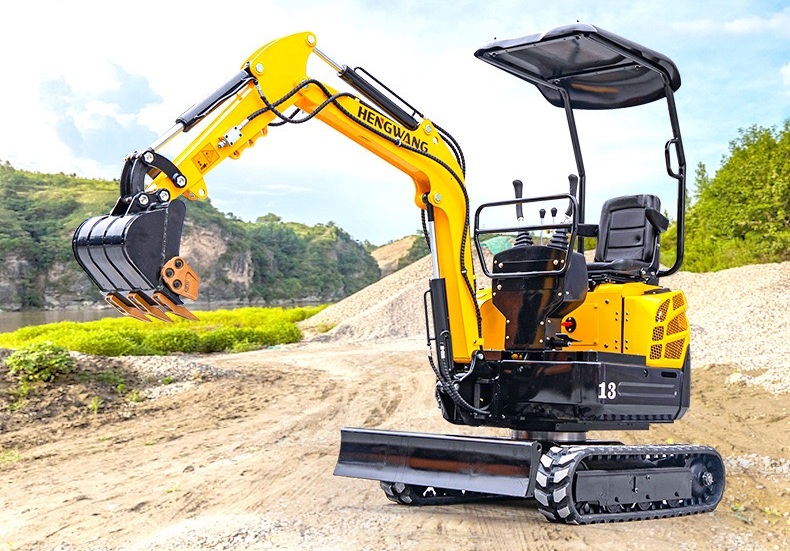
Excavator control type directly affects operator efficiency, comfort, and working precision. Choosing the right control system is essential for improving productivity and reducing operator fatigue.
GTFI mini excavators offer mechanical control, pilot (hydraulic) control, and hydraulic pilot control options, covering everything from entry-level to professional applications.
1. Mechanical Control
How it works: Mechanical linkages directly connect the control levers to the hydraulic valve bank. The operator's movements are transmitted mechanically to control the hydraulic system.
- Best for: Small excavators, entry-level operators, budget-conscious buyers
- Advantages: Simple construction, low cost, easy maintenance, high reliability
- Disadvantages: Heavier operation, lower precision, operator fatigue with extended use
- GTFI models: 10-1, 10-2
2. Pilot (Hydraulic) Control
How it works: Control levers operate pilot hydraulic circuits that actuate the main control valves via pilot valve blocks, enabling precise hydraulic system control. Light and precise operation.
- Best for: Medium-tonnage excavators, precision work, frequent use
- Advantages: Light operation, high precision, responsive, comfortable
- Disadvantages: Higher cost, more complex system, requires professional maintenance
- GTFI models: 13W, 15, 16W, 17-2, 20W, 25, 26, 30, 35, 35W
3. Hydraulic Pilot Control
How it works: An upgraded version of pilot control with a more advanced hydraulic pilot system, offering even smoother and more precise operation.
- Best for: High-precision work, professional applications
- Advantages: Ultra-smooth operation, highest precision, excellent fine control
- GTFI models: 17-1, 18W-1/2
4. Detailed Comparison Table
| Feature | Mechanical | Pilot (Hydraulic) | Hydraulic Pilot |
|---|---|---|---|
| Operation Effort | Heavier | Light | Lightest |
| Control Precision | Moderate | High | Highest |
| Operator Comfort | Moderate | Excellent | Excellent |
| System Complexity | Simple | Moderate | Moderate-High |
| Maintenance Cost | Low | Moderate | Moderate |
| Machine Cost | Low | Moderate | Higher |
| Suitable Tonnage | ≤1 ton | 0.6-3.5 tons | 1-3.5 tons |
5. How to Choose?
Choose mechanical control if:
- Budget is very limited
- Used for simple digging tasks
- Operator has less experience
- Machine tonnage is under 1 ton
Choose pilot (hydraulic) control if:
- Precision work is required
- High-frequency operation
- Operator comfort is a priority
- Machine tonnage is 1-3.5 tons
Choose hydraulic pilot control if:
- Highest precision is required
- Professional-level applications
- Superior operating experience is desired
Practical Selection Checklist
Construction equipment should be selected around the job rather than around machine size alone. Excavators, transporters, and attachments must work within site access, ground conditions, lifting limits, transport restrictions, and the required production rate.
What to Confirm Before Ordering
- Define the material, digging or carrying task, working depth, reach, and expected daily workload.
- Check operating weight, machine width, height, ground clearance, turning space, and transport dimensions against the job site.
- Match engine power, hydraulic flow, attachment compatibility, and control system to the intended attachment and duty cycle.
- For tracked machines, consider slope, ground pressure, traction, mud, and the balance between mobility and payload.
- Confirm service access, wear parts, attachment availability, transport arrangements, and operator requirements before ordering.
For a quotation request: For quotation requests, provide the site conditions, required attachment, material, working depth or payload, access limits, destination country, and expected quantity. This produces a much more useful equipment recommendation.
Need help matching equipment to a specific application? Provide the operating conditions, required quantity, destination, and key technical requirements when requesting a quotation.
❓ Frequently Asked Questions
A: Pilot-controlled excavators typically cost 10-20% more than mechanical control models of the same tonnage, but offer significantly better operation and precision.
A: Technically yes, but it requires replacing the entire hydraulic system and control components. It's more cost-effective to purchase a pilot-controlled model directly.
A: Mechanical control is more direct and helps beginners understand basic excavator operation. Pilot control is easier on the operator and better for precision work.
A: Hydraulic pilot control is a more advanced version with a more precise pilot system, offering smoother and more accurate operation. It's typically found on higher-end models.
💬 Not sure which control type is right for your needs?
Talk to Our Experts →